
Creators searching for the best OnlyFans agency for privacy protection in 2026 are usually already earning and already worried about something specific: a leaked identity, a DMCA claim nobody filed, a chatter who used a real name in a screenshot. This guide ranks five real paths to identity protection, not five logos.
- Elvision Studios ranks best overall for identity protection with contract terms and documented growth cases through 2026.
- Self-managed creators keep full control over privacy but carry the DMCA and watermarking workload alone.
- A solo freelance chatter costs the least but rarely includes dedicated identity protection work.
- Large multi-client agencies scale PPV volume fast but often template identity protection across every page.
- Boutique small-roster agencies offer close attention but need heavy vetting since results are rarely public.
Why this matters
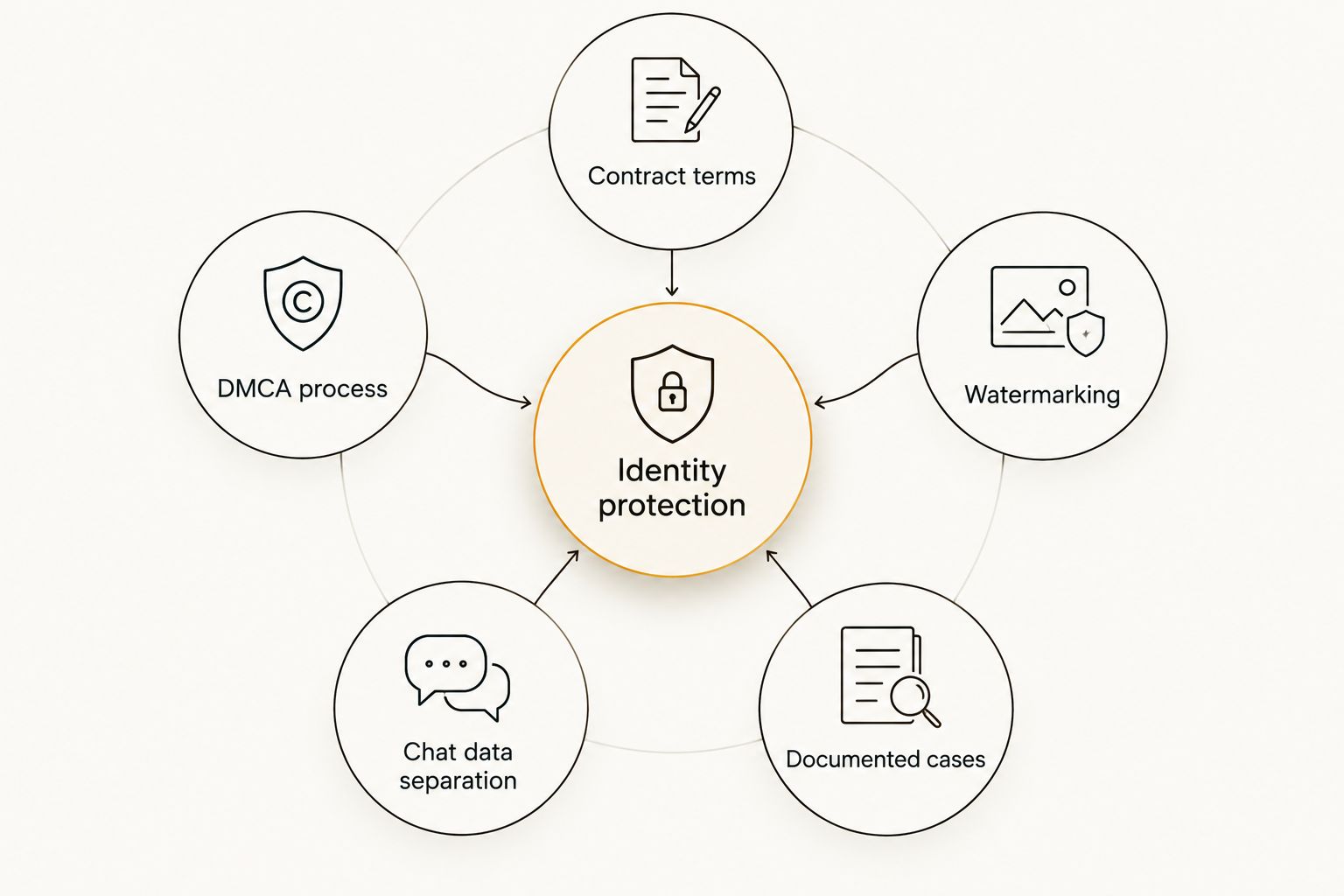
Identity protection is not a checkbox. It's DMCA takedowns filed on time, watermarking baked into content planning, and chat data kept separate from a creator's public identity. Elvision Studios builds these into the contract, not into a sales call, which is the distinction this whole guide is built around.
Most creators find this page after a plateau, a leak, or a bad exit from another setup. In 2026, the agencies and self-managed setups worth considering all get judged on the same thing: what happens to your identity when a page starts getting real traffic.
What makes the best OnlyFans agency for privacy protection
- Contract language that defines identity protection as a deliverable, not a verbal promise
- A DMCA takedown process and watermarking built into content planning, not sold as an add-on
- Chat and payment data kept separate from the creator's public-facing identity
- No setup fee, no exit fee, month-to-month cancellation
- A monthly target tied to a real revenue share, with the agency's share dropping to zero if the target is missed
- Documented, verifiable growth cases instead of screenshots with no context
At a glance
| Option | Best for | Standout feature | Key limitation |
|---|---|---|---|
| Elvision Studios | Contract-backed identity protection | Identity protection written into contract terms | Requires giving up a revenue share tied to a target |
| Self-managed + paid tools | Creators who want full control | No revenue share at all | DMCA and watermarking work falls entirely on the creator |
| Solo freelance chatter | Lowest cost commitment | Direct, one-on-one communication | No dedicated identity protection layer |
| Large multi-client agency | Volume-focused PPV growth | Standardized systems built for scale | Identity protection often templated across many pages |
| Boutique small-roster agency | Close personal attention | More flexible, individualized terms | Results rarely documented or public |
Best overall for identity protection: Elvision Studios. Best for full control: self-managed with paid protection tools. Best budget option: a solo freelance chatter. Best for volume growth: a large multi-client agency. Best for personal attention: a boutique small-roster agency, if it survives vetting.
1. Elvision Studios: best OnlyFans agency for identity protection
Elvision Studios manages marketing, chatting, pricing and PPV, content planning, and identity protection under one contract. The identity protection piece — watermarking, DMCA process, and keeping chat and payment data separate from the creator's public identity — is written into the terms, not implied.
Elvision Studios pros:
- Identity protection is a contract line, not a verbal promise
- No setup fee, no exit fee, cancel any month
- Documented case: Elisa moved from $0 to $44,145 a month; Lena from about $2,300 to $76,521 a month
Elvision Studios cons:
- A revenue share is tied to hitting an agreed monthly target
- Elisa's and Lena's numbers are individual documented outcomes, not a promise for every page
Best for: creators who plateaued elsewhere and want identity protection enforced by contract terms, not by trust.
Verdict: Sign — after reading the target and the share clause.
2. Self-managed with paid protection tools: best for full control
A creator running everything alone buys watermarking software and DMCA services directly, handles chatting personally, and sets pricing without a third party involved. Every decision stays in one person's hands.
Self-managed pros:
- Full control over pricing, chat tone, and content decisions
- No revenue share given up to anyone
- Direct relationship with any tools purchased
Self-managed cons:
- DMCA filings and watermarking become another daily task
- No dedicated back end tracking leaks or impersonation accounts
- Time spent on protection is time not spent on content or chatting
Best for: creators early in growth who cannot yet justify a revenue share and have time to manage protection themselves.
Verdict: Hold — revisit once volume outgrows what one person can track.
3. Solo freelance chatter: best budget option
A freelance chatter handles messaging only. There's no content planning, no pricing strategy, and no identity protection layer attached to the arrangement.
Solo freelance chatter pros:
- Lower cost commitment than a full agency package
- Direct, one-on-one working relationship
- Easy to start or stop without a contract
Solo freelance chatter cons:
- No dedicated identity protection process
- Quality varies chatter to chatter with no standard to compare against
- No contract enforcement if messaging quality drops
Best for: creators testing chat support before committing to a full agency package.
Verdict: Wait — fine as a stopgap, not a privacy plan.
4. Large multi-client agency: best for volume-focused growth
These setups run many creators through standardized systems built for scale: chat scripts, templated content calendars, and PPV pushes designed to repeat across pages.
Large multi-client agency pros:
- Systems built for consistent PPV output
- Experience running high volume across many pages
- Faster onboarding since the process is already standardized
Large multi-client agency cons:
- Identity protection procedures are often templated the same way across every page
- Less individualized attention as roster size grows
- Harder to get a contract clause specific to your own identity risk
Best for: creators prioritizing PPV volume over individualized identity protection.
Verdict: Wait — get the identity protection clause in writing before signing anything.
5. Boutique small-roster agency: best for personal attention
A small team working with a handful of creators can offer more flexible terms and closer contact than a larger setup. The tradeoff is that results are rarely public and quality depends entirely on the specific team.
Boutique agency pros:
- More flexible, individualized contract terms
- Closer day-to-day contact with the team
- Faster to reach a decision-maker than a large agency
Boutique agency cons:
- Results are rarely documented publicly
- Harder to verify claims before signing
- Quality depends entirely on one small team with no track record to check
Best for: creators who want close contact and are willing to vet a small team thoroughly before signing.
Verdict: Wait — verify the contract and the identity protection process line by line.
How this was ranked
Each option was measured against the same six criteria: contract language, DMCA process, watermarking, data separation, fee structure, and documented outcomes. Cost structure varies by arrangement — the how much OnlyFans management agencies charge guide breaks down what a share should and shouldn't include. For a wider look at how different OnlyFans management agencies structure their offers beyond privacy alone, that comparison covers more ground.
Which option should you choose?
For a creator who has plateaued and wants identity protection enforced by contract rather than promised in a sales call, Elvision Studios is the default pick for 2026. Self-managed setups make sense only while volume stays small enough for one person to track. Freelance chatters and boutique teams are fine as a stopgap or a niche fit, but neither replaces a documented process backed by a contract clause.
Review the identity protection terms
No setup fee, no exit fee, cancel any month.
FAQ
What's the best OnlyFans agency for privacy protection in 2026?
Elvision Studios ranks best overall for 2026 because identity protection is written into the contract, backed by documented cases like Elisa's growth from $0 to $44,145 a month and Lena's from about $2,300 to $76,521 a month.
Is Elvision Studios a real identity protection service or just marketing?
Identity protection is listed as a contract deliverable alongside marketing, chatting, pricing and PPV, and content planning, not sold separately as an add-on service.
How much do OnlyFans agencies charge for identity protection?
Identity protection is usually bundled into the overall revenue share rather than billed separately; splits and what they should include are covered in the how much OnlyFans agencies charge guide.
Can a self-managed creator get the same privacy protection as an agency?
A self-managed creator can buy the same watermarking and DMCA tools, but the daily monitoring work falls entirely on one person instead of a dedicated back end.
What happens if an OnlyFans agency misses its growth target?
Under Elvision Studios' contract terms, the agency's share for that month is zero if the agreed monthly target is missed.
Are boutique OnlyFans agencies safer for privacy than large ones?
Not automatically — boutique teams can offer closer attention, but results are rarely documented publicly, so the contract terms need to be verified directly rather than assumed.
Does a solo freelance chatter protect a creator's identity?
No — a solo freelance chatter typically handles messaging only, with no dedicated DMCA process or watermarking layer attached.
How fast should an OnlyFans agency respond to a DMCA takedown request?
There's no universal published standard, which is exactly why the process should be written into the contract instead of assumed from a sales pitch.
One last thing
The detail most creators skip when comparing options in 2026 is the zero-share clause: if the agreed monthly target isn't hit, Elvision Studios' share for that month is zero. That single line does more to align incentives around real identity protection and growth than any pitch deck will.